

Arizona Written Driving Test: What to Expect - EZ Title & Registration
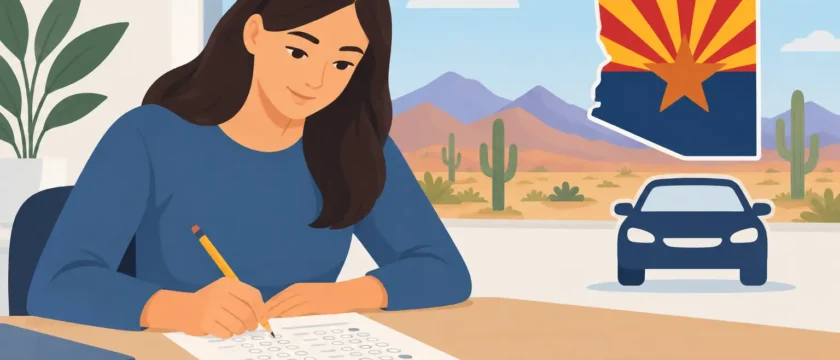
The Arizona written driving test is not meant to trick you. It is meant to confirm that you can make safe decisions before you get behind the wheel. Still, a few signs, right-of-way rules, and alcohol laws can turn an otherwise easy question into an MVD mystery if you have not reviewed the right material.
The good news: you do not need to memorize every sentence in a driver manual. You do need to understand the rules Arizona expects you to use on real roads – from neighborhood intersections and freeway entrances to school zones and desert highways. Start with the outcome: pass the knowledge test, get the permit or license step handled correctly, and move on with your day.
What the Arizona written driving test covers
The written test, also called the knowledge test, checks whether you understand Arizona traffic laws, road signs, pavement markings, and safe driving practices. Questions are generally multiple choice and based on the Arizona driver license manual.
Expect questions about who has the right-of-way at intersections, what different signs and signals mean, how to share the road with pedestrians and cyclists, and what to do around emergency vehicles, school buses, and work zones. You may also see questions about speed limits, stopping distance, distracted driving, impaired driving, and Arizona-specific licensing rules.
This is why casual driving experience is helpful but not enough. A parent or friend may have taught you good habits, but the test is looking for the rule that applies in a specific situation. If two answers seem possible, choose the one that is safest and follows the law.
Signs and markings deserve extra attention
Many test-takers spend most of their study time on right-of-way questions, then lose points on signs. Do not let a red octagon, yellow diamond, or white regulatory sign catch you off guard.
Learn signs by shape, color, and message. A sign’s shape often tells you what category it belongs to before you can read it. Also review lane markings: solid versus broken lines, yellow versus white lines, center turn lanes, and crosswalk markings. These details show up on the test because they matter when traffic is moving around you.
Know the rules behind common situations
Focus on situations that require a decision, not just a definition. Think about what you should do when approaching a flashing signal, entering a roundabout, meeting a stopped school bus, or coming to a four-way stop at the same time as another vehicle.
Arizona roads create some practical situations worth studying, too. Know how to handle dust storms, monsoon rain, heat-related vehicle problems, and long-distance driving. The written test may cover safe responses to hazardous conditions, even if your daily drive is only a few miles.
How to study without cramming random answers
Start with the current Arizona driver license manual. Read it in short sections rather than trying to finish everything in one sitting. The goal is to connect each rule to a driving situation you can picture.
After each section, use practice questions to find weak spots. Do not simply memorize that Question 12 has answer B. Read why the answer is correct. If you miss a question about a yield sign, return to the manual’s sign section and make sure you understand the rule before moving on.
A useful study routine is to review signs one day, traffic laws the next, and safe-driving rules after that. Then take a mixed practice test. This approach is more effective than repeatedly taking the same quiz until the answers look familiar.
If English is not your first language, give yourself more time to review the wording in the manual. The test checks driving knowledge, but careful reading matters. Ask about available testing options before your appointment if you need language support or an accommodation.
What to bring and handle before test day
Test-day requirements depend on your age, residency status, and whether you are applying for a first permit, a first Arizona license, or another credential. A teen applying for an instruction permit may have different paperwork requirements than an adult new to Arizona.
Before you go, confirm the documents required for your specific transaction. Identification, proof of Arizona residency, Social Security information when applicable, and parental consent for minors are common areas where applicants run into delays. Original or acceptable certified documents matter. A photo on your phone of a document may not do the job.
If you are under 18, make sure a parent or legal guardian is ready to complete any required consent. If you are an adult transferring from another state, check whether your existing license and your immigration or identity documents affect the process. A little preparation beats making a second trip because one piece of paperwork stayed on the kitchen counter.
At EZ Title Service, testing appointments can help you plan around school, work, and the rest of life. Bring your documents organized, arrive with time to spare, and let the staff know what outcome you are working toward – permit, license, or a required knowledge test tied to another licensing step.
How to approach the test questions
Read every question all the way through before looking at the answers. Watch for words such as “must,” “always,” “unless,” and “best.” They can change the meaning of the question.
Use what you know about safe driving when you are unsure. The correct answer is rarely the aggressive option. Speeding up to beat a yellow light, assuming another driver will yield, or following too closely are not safe choices, and they are not likely to be the answer the test wants.
Do not rush just because other people finish first. Take a breath, reread questions that feel confusing, and answer based on the rule rather than what you have seen someone do in traffic. Arizona drivers do plenty of things that are not legal, safe, or test-worthy.
If you do not pass on the first try
A missed test is frustrating, but it is useful information. It tells you where your preparation needs work. Ask which subject areas gave you trouble if that information is available, then study those sections before trying again.
Avoid the temptation to immediately retake the test without reviewing anything. If signs were the issue, work through every sign category. If right-of-way questions were the problem, draw a few intersection scenarios on paper and talk through who goes first and why. Understanding the rule will carry you further than guessing differently next time.
Keep in mind that testing and retesting policies, fees, and appointment availability can change. Check the current requirements before you make plans, especially if you are trying to finish a permit or license step by a school, job, or travel deadline.
After you pass the knowledge test
Passing the written test is a milestone, but it may be one part of the licensing process. Depending on your situation, you may need to complete vision screening, have your photo taken, receive an instruction permit, log required supervised driving time, or schedule a road test later.
For new drivers, use the permit period to practice the exact skills the written test introduced: scanning intersections, recognizing signs early, keeping a safe following distance, and making calm decisions when conditions change. The road test is where those rules need to look natural from the driver’s seat.
Bring the same practical mindset to every step. Prepare your documents, study the current rules, and ask questions before a small paperwork issue becomes a bigger delay. The Arizona written driving test is one checkpoint on the way to driving independently – and with the right preparation, it is a very manageable one.
Leave A Comment